
Algae that Produce Energy Rich Biomass from CO2 and Water
We have to start thinking of CO2 as a resource and not as a waste byproduct to be pumped underground or worse, released to the atmosphere. This is particularly true of the cement industry which produces more CO2 than in proportion to the energy used because of the chemical release of the gas from the calcination of limestone.
Algae comprise a vast group of photosynthetic organisms, which have an extraordinary potential for cultivation as energy crops. They can be cultivated under difficult agro-climatic conditions and are able to produce a wide range of commercially interesting compounds such as hydrogen, fats, oils, sugars, carbohydrates and functional bioactive compounds from water and CO2 using light as a source of energy. Some strains of algae are effective for the manufacture of hydrocarbons that are suitable for direct use as high-energy liquid fuels. Alcohols can be made from cellulose produced by many other algae and the hunt is on for suitable strains and genetic material. Producing fuel from carbon dioxide by using photosynthetic algae is important not only because the process will offset the decline in oil, but because it also attracts carbon credits and insulates agains oil price rises. With many other resources starting to run out substitute timbers, papers, fabrics and foodstuffs that algae can produce are also of interest.
The Australian government is allocating $500 million for solutions to excess carbon dioxide, preference being given so far to re-engineering coal power stations or geosequestration. I have grave concerns about the latter and have expressed them publicly (see The TecEco - Greensols Pty. Ltd. - Submission to the Inquiry into Geosequestration Technology by the House of Representatives Standing Committee on Science and Innovation in Australia.) Note that Gaia Engineering is the new name for the CarbonSafe project mentioned in the document.
It would have been far more constructive to be chasing uses for CO2 rather than just burying it. But maybe the hidden agenda is that oil companies want to use CO2 to push up more oil.
The new Gaia Engineering tececologies offered by founding Global Sustainability Alliance members will require methods for sequestering gaseous CO2 from the TecEco Tec-Kiln and Carbonate/Hydroxide Slurry sequestration process and the building of bio reactors to manufacture oils, methanol, ethanol or other fuels from carbon dioxide is a much safer alternative to geosequestration.
Many factors including light, temperature, water and nutrient levels have to be considered for efficient algal cultivation and these vary depending on the particular species or strain. Worldwide research projects have been undertaken to identify suitable growth conditions, nutrient media, specific high yielding strains of algae, and other aspects of cultivation and some ar listed below as case studies.
Case Studies
ACC Project to Recycle CO2 From Cement Kilns into High Energy Algal Biomass Coal Equivalent Fuel
ACC, formerly Associated Cement Companies and now part of the Holcim group have initiated a project to sequester CO2 generated by cement kilns to produce high energy algal biomass, which will then be reused as fuel in its cement kilns. The plan is that the biomass produced by the right strains will be directly fired in power plants and kilns. One of the main goals of the ACC project is to harmonize the algal production rate with CO2 emission rates.
The project involves the screening of appropriate high yielding algae cultures, the development of a bioreactor on a lab bench scale, scaling up the technology to a pilot plant and then demonstrating the same commercially. This will require a multi disciplinary approach and involve microbiologists, algae experts, bio-technologists, engineers and other professionals and cost around $ 3m over a period of 3 years.
Aquatic Species Program (1978-1996)
The ASP was a research program funded by the US Department of Energy, which over the course of two decades looked into the production of energy using algae, later on the aim of the program was focused to the production of bio-diesel from algae using CO2 from coal fired power plants resulting in CO2 sequestration. The researchers colleted about 3000 species from all over North America which had a high lipid content. The programme demonstrated CO2 recycling by coupling a coal-fired power plant with an algae farm and a 1000 square metre pond system was established in Roswell, New Mexico. The achieved yield from the algal farms was of 50 grams of algal biomass per square meter per day. However, the major problem of the programme was that the yield could not be obtained consistently due to occasional low temperatures, wide swings in temperature and pH, and competition from invasive algae and bacteria.
Greenfuel Technologies Corporation and Massachusetts Institute of Technology Air-liftreactor (ALR)
GreenFuel Technologies Corporation in collaboration with Massachusetts Institute of Technology (MIT), have demonstrated a reduction in CO2 emission by 82 percent on sunny days and 50 percent on cloudy days (during daytime) and has cut nitrogen oxides by 85 percent (on a 24-hour basis) using their using their air-lift bioreactors. The installation at MIT’s 20-megawatt cogeneration plant demonstrates their feasibility and they comprise thirty 3-meter-high triangles of clear pipe containing a mixture of algae and water. The flue gas from the stack is bubbled through the mixture and is harnessed by algae into biomass. The concept of the green fuel Airlift bioreactor is based on photomodulation, in which fluid circulation takes place in a defined cyclic pattern through a glass pipe riser tube and down comer channel. In the riser, gas injection produces a highly turbulent region with high gas holdup. In the down comer, the liquid returns to the bottom after separating from the gas bubbles that disengage in the gas separator. According to GreenFuel, full scale implementation at a 1000 MW coal-fired power plant, processing 100% of the plant’s flue gas (containing 10-15% CO2) will require 10,000 to 15,000 acres in reactive surface area and is estimated to reduce CO2 emissions by up to 3.5 millions ton/yr.
Using GreenFuel’s Emissions-to-Biofuels algae bioreactor system connected to the Arizona Public Service Co.’s 1,040 megawatt Redhawk power plant in Arlington, Arizona, GreenFuel was able to create a carbon-rich algal biomass with sufficient quality and concentration of oils and starch content to be converted into transportation-grade biodiesel and ethanol. GreenFuel and APS were recognized for their work and were awarded the 2006 Platts Global Energy Award for “Emissions Energy Project of the Year.” GreenFuel has also signed an agreement to license its proprietary technology to Global Renewable Energy Efficiency Network, a newly formed biofuels company in the Republic of South Africa. Global Renewable is headquartered in Johannesburg and led by Frik DeBeer and Hendy Schoonbee, pioneers in South Africa’s biodiesel industry. Under the terms of the agreement, Global Renewable will have the rights to install and operate GreenFuel’s Emissions- to-Biofuels™ algae bioreactor systems at multiple locations with commercial deployment potential of 1,000 acres or more.
Victor Smorgan Group Australia
GreenFuel Technologies has also signed a licensing agreement with The Victor Smorgon Group (VSG) headquartered in Melbourne, Australia granting them and exclusive license to distribute, install and operate GreenFuel’s Emissions-to-Biofuels proprietary technology throughout Australia and New Zealand.
Under terms of a recently signed deal, VSG will establish a small plant at Hazelwood to test the process. VSG at present produces 12 million litres of biodiesel at its Laverton plant and is in the process of boosting this to 100 million litres. It uses canola, used cooking oil and tallow as feedstock, but recently installed a small facility to turn micro algae to biofuels.
Carbon dioxide emissions are fed into a network of plastic tubes holding water, algae and nutrients. Through the action of sunlight on the outside of the tubes, photosynthesis occurs and the algae convert the carbon dioxide to oils, protein and carbohydrates in approximately equal parts. The oils are turned into biodiesel, the carbohydrates can be converted into ethanol and the proteins can become stockfeed.
Theoretically the process could be used to sequester 42.5 per cent of the output of Hazelwood (or any other carbon dioxide-emitting facility). This figure is calculated on the basis that micro-algae can process 85 per cent of emissions fed into the tubes. But because photosynthesis occurs only in daylight hours, the sequestration process only happens for an average of 12 hours a day.
On the face of it, the economics of the process look promising. Canola and oil palm produce 1000 and 5000 litres of palm oil per hectare of crop a year. The micro-algae process would produce between 80,000 and 120,000 litres of biodiesel from a hectare of land a year, Mr Edwards said.
Because the tubes holding micro-algae must be exposed to sunlight, production plants need to be spread over a wide area. Mr Edwards said the process could deal with 700 tonnes of carbon dioxide per hectare of pipes. The experimental plant will cover about 60 metres by 10 metres and will sequester only a small amount of carbon.
If the test is successful, International Power and VSG will discuss joint-venture arrangements to roll out the technology commercially at Hazelwood, where there are about 1000 hectares available for the process. That could allow the sequestration of about 5 per cent of Hazelwood's 17 million tonnes of annual carbon dioxide emissions. If the process proves attractive, International Power will look at other potential sites in its international generation portfolio.
One advantage of the technology is that it does not raise costs for power generators or electricity consumers. Whereas processes such as geosequestration are expected to cost about $80 per tonne of carbon dioxide buried in the earth, micro-algae sequestration is a profitable business in itself.
If the process gets rolled out commercially it would significantly advance Australia's biofuels industry, producing both ethanol and biodiesel. Stockfeed with the residues will help a drying continent support its agricultural industries. What is not used more profitably can be dried nd converted into biomass fuels for power stations.
Greenshift Industrial Design Corporation (GIDC) and Ohio University’s (OU)
Cynaobacteria based bioreactor developer GIDC have obtained a non-exclusive license from Ohio University for its patented bioreactor technology for reducing greenhouse gas emissions from the smokestacks of fossil fueled power plants and exclusive rights to the technology for the air pollution control of exhaust gas streams from all other sources. The reactor is composed of parabolic mirrors, fiber optic cables and slabs of acrylic plastic called "glow plates". They system uses the parabolic mirrors to collect sunlight and channel it along plastic fiber-optic cable. The algae grow on membranes of woven fibers resembling window screens interspersed between the glow plates. Capillary action wicks water to the algae, fiber optic cables channel sunlight into the glow plates, and ducts bring in the hot flue gas. By growing the algae on the membranes a lot of surface area is created. Thus only a small amount of water is needed. When the algae grows to maturity it drops to the bottom of the chamber where it can be harvested for use as fuel, fertilizer or a soil stabilizer.
Penthouse Photobioreactor at the Academic and University Center of Nove Hrady
The Academic and University Centre of Nove Hrady, Czech Republic has developed the "penthouse-roof" photobioreactor which is based on solar concentrators with linear Fresnel lenses mounted in a climate-controlled greenhouse on top of the laboratory complex combining features of indoor and outdoor cultivation units. The dual-purpose system was designed for algal biomass production in temperate climate zone under well-controlled cultivation conditions and with surplus solar energy being used for heating service water. The system was used to study the strategy of microalgal acclimation to high solar irradiance, with values as much as 3.5 times the ambient value, making the approach unique.
Oak Ridge National Laboratory and Ohio University - Solar Lighting for Growth of Algae in a Photobioreactor
The ORNL/Ohio University project is demonstrating the feasibility of using remote solar lighting systems to enhance sunlight utilization and biomass production in photobioreactors. Large solar collectors on the roof track the sun, collect sunlight, and distribute it through large optical fibers to the bioreactor's growth chamber. The fibers function as distributed light sources to illuminate cyanobacteria (algae). Each growth chamber consists of a series of illumination sheets containing the optical fibers and moist cloth-like membranes on which the algae grow. By stacking the membranes vertically and better distributing the light, more algae can be produced via photosynthesis in a smaller area. Ohio University photobioreactors use sunlight to sequester carbon from coal-fired power plans as they produce biomass. The Ohio University reactor will ultimately remove the carbon generated by the production of about 125 MW of electricity in a coal fired power station.
Valcent Products Inc “Clean Green” Vertical Bio-Reactor
Valcent Products Inc., has developed a proprietary high density vertical bio-reactor for the mass production of oil bearing algae. This new bio-reactor is tailored to grow a species of algae that yields a large volume of high grade vegetable oil and which is very suitable for blending with diesel to create a bio-diesel fuel. The system consists of a series of closely spaced vertical bio-reactors constructed of thin film membranes allowing high levels of light penetration. The membrane is configured for an optimum flow for the growth of algae. This dynamic system produces much higher algae growth rates than conventional static systems. When fully operational, the system will yield a constant supply of algae which is harvested, dried and processed to remove the oil, leaving a residue of some 50% by weight, which can also be sold for a variety of commercial products. The system has a closed loop allowing for a greater retention of water and eliminating cross contamination by other algae species. Valcent’s new system has indicated a production yield of up to 150,000 gallons per acre per year using extrapolated data from its test bed facility and the company has entered into an agreement with Global Green Solutions Inc. to form a “Vertigro”joint venture for funding the next phase of development of the technology including the completion and testing of a fully operational demonstration pilot plant over the next 9 months.
University of California at Berkeley and the U.S. Department of Energy Hydrogen from Algae.
Algae have long been known to produce minuscule amounts of hydrogen. The trouble is, the enzyme that propels the reaction (hydrogenase) stalls in the presence of oxygen, and algae naturally produce oxygen during photosynthesis.
University of California researcher Tasios Melis found he could reprogram photosynthesis and stifle internal oxygen flow by depriving the plant cells of sulfur. Under these conditions the algae pumped out hydrogen in significant quantities. With genetically engineered increases in hydrogenase, the quantity is expected to be more..
University of Texas Methanol production from Cellulose made by Blue Green Algae
Malcolm R Borwn leads a laboratory at the university of Texas that are working on cellulose production by algae. So fare they have discovered cellulose biosynthesis in nine species of cyanobacteria, or blue-green algae which may be the source of the genetic material used for cellulose biosynthesis in present-day plants.
There are well researched ways of making methanol from cellulose and this combined process could be more effiicient..
Conclusions in Relation to the Gaia Engineering Project
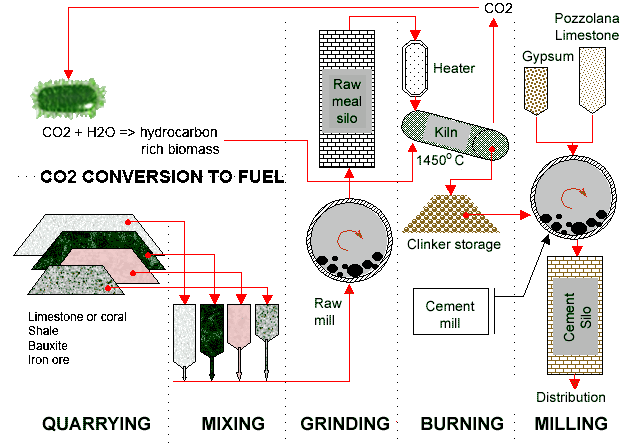
Incorporation of On-Site Fuel Production with Cement Manufacture
There are a growing number of researchers at the forefront of this exciting new field and future research will involve determination of the operational and economic feasibility of algal culture systems for organic biomass production. The scope for utilising cement kiln emissions is exciting because the fuel produced could be used on site. The burning of limestone also releases chemically bound CO2 so that excess fuel produced could be converted to biodeisel for use in delivery vehicles.